
Stop Asking AI to Answer. Let It Interview You.
Why the Best First Move Is Letting AI Surface What You Know but Never Say.

When Sir William Osler taught medicine, he made his students do something odd for 1890. He took them out of the lecture hall and stood them at the patient's bed. Osler, one of the four physicians who founded Johns Hopkins, had noticed that the students who diagnosed best weren't the ones who'd memorized the most. They were the ones who knew how to ask.
"Listen to the patient," Osler would tell his students, "he is telling you the diagnosis."
The answer was usually already in the room. Sitting inside the patient's own account: the aches, the timeline, the thing they almost didn't bother to mention. The doctor's real skill was asking the right questions until what the patient already carried came out.
That's the move almost nobody makes with AI.
We treat it as the thing that knows. So we hand it a blank page and ask it to generate. And then when what comes back is generic, we're disappointed because we briefed it with a fraction of what we actually know.
You know the rest. It just never makes it in.
The Generator Reflex
Point AI at a task, and get an output. That's the default, and it feels productive.
But the ceiling on that output is everything you didn't tell it. Everything you didn't know you needed to. The context that's so obvious to you that it never occurred to you to type it. The constraint you'd recognize in a second if someone named it, but wouldn't think to volunteer.
That's the expensive gap. Not the things you know you don't know. The things you know so well they've gone invisible.
And a vague brief fails you twice. Too little context and the model fills the space with industry-average best practice that doesn't fit your situation. Too much rigid instruction and it follows you off a cliff, executing exactly what you said when a good collaborator would have pushed back. You don't find out which one happened until the work comes back wrong.
The model knew plenty. You just never got what you know out of your own head.
Let It Play Osler
The shift is to stop asking AI to answer, and start letting it ask.
Thariq Shihipar, who builds with these tools every day, wrote the sharpest version of this I've read. He calls it finding your unknowns.

His frame is code, but the idea walks straight into any knowledge work. He borrows the old four-box model: known knowns, known unknowns, unknown unknowns, and the one that matters most here, unknown knowns. The things so obvious you'd never write them down, but would recognize the instant you saw them.
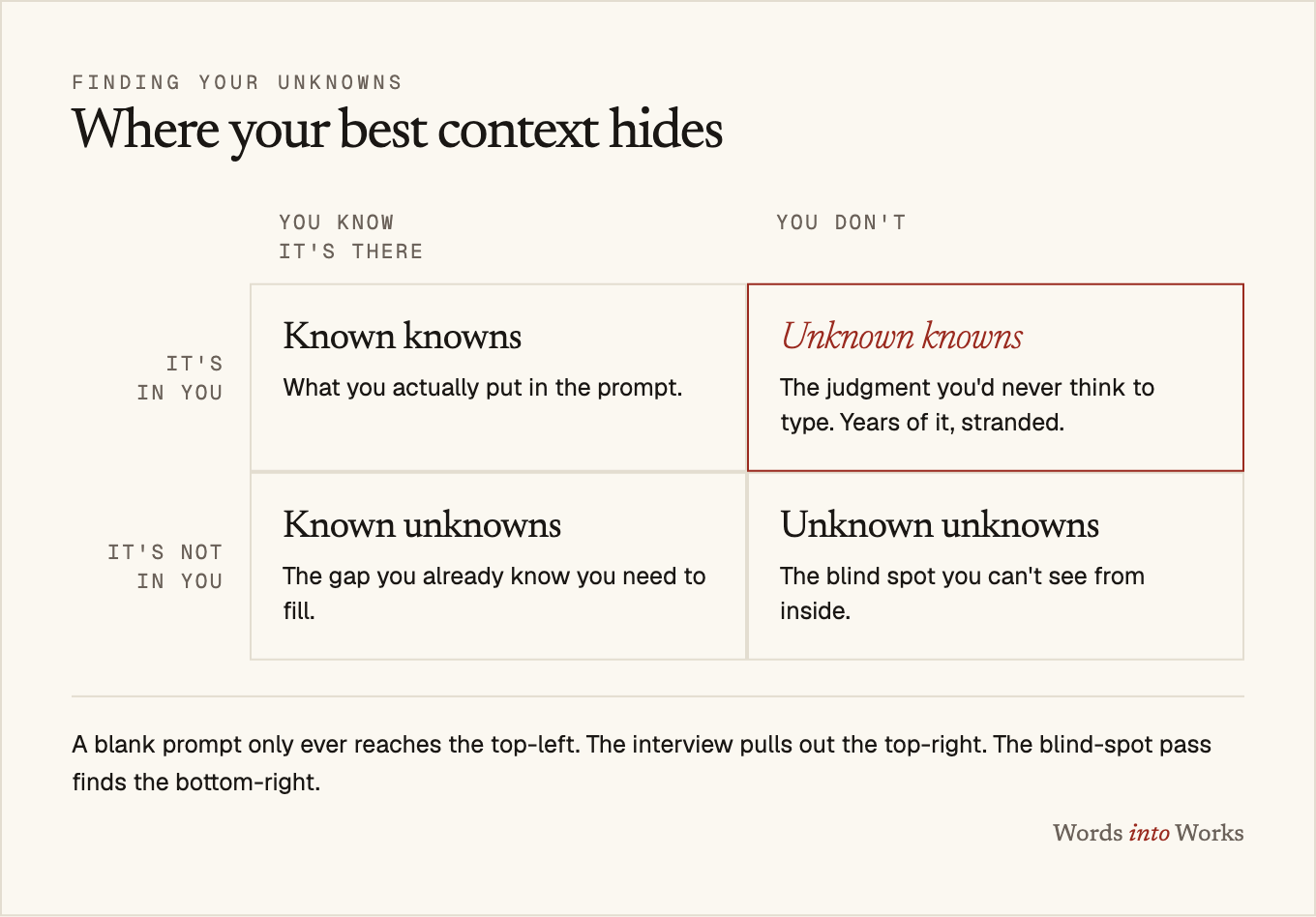
That last box is your accumulated judgment. Years of it. And it's stranded, because nothing ever asks you for it. A blank prompt certainly doesn't.
So flip the roles. The most useful thing AI can do at the start of a task is interview you. Play Osler, and pull the diagnosis out of you before it writes a word.
I Aimed It at the Page I Knew Cold
I was in the middle of writing this issue when I decided to stop describing the move and actually run it. So I pointed a blind-spot pass at my own newsletter's positioning. A page I'd been rewriting for a year (and quietly calling done), the one doc I'd have sworn had no surprises left in it. I asked it to find what I couldn't see, interview me on the sharpest thing, and not let me off the hook until I answered.
It asked me this:
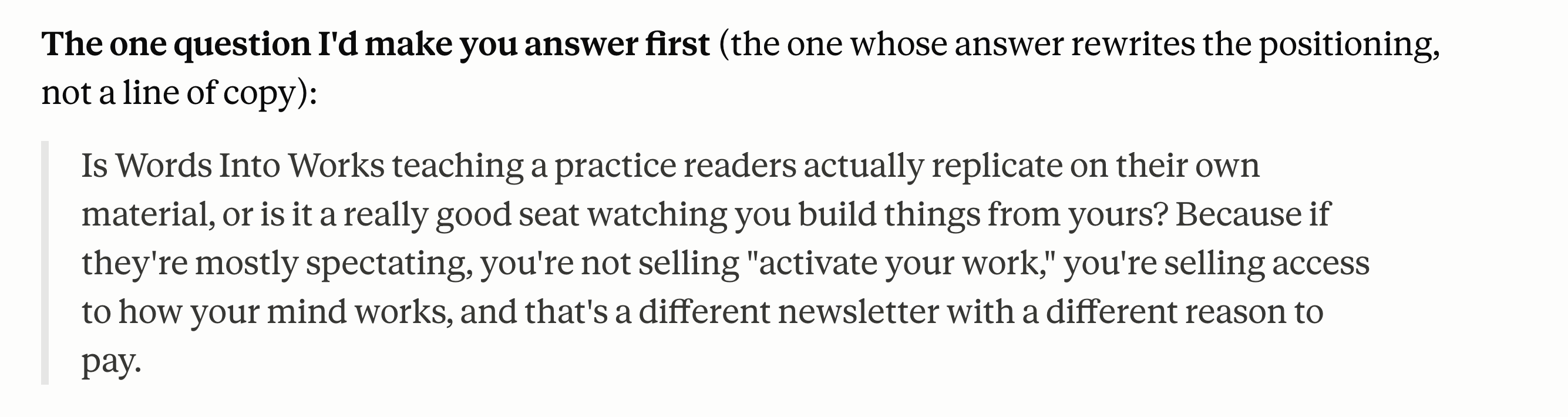
I sat with that longer than I'd like to admit. Because I had an answer. I'd had it the whole time. It just never made it onto the page (I'd never once said it out loud), and the specifics stay between me and the doc. One question, and a doc I knew cold read like someone else had written it.
I didn't need a special tool for that. Two prompts do most of the work. One caveat first: AI can only interrogate what it can see, so paste the doc in, or run these where you've already been working on it. Aim a blind-spot pass at something it can't read and it'll invent generic ones.
First, the interview, for pulling out what you know but haven't said:
Interview me one question at a time about [what I'm working on]. Prioritize the questions where my answer would change the whole direction. Don't move on until I've answered.Then, the blind-spot pass, for what you can't see because you're standing too close:
Tell me what I don't know I don't know about [what I'm working on].Then ask me the single question I've been avoiding.
It can't hand you knowledge you've never encountered, and it can't decide for you. But it can surface what's already in you and put the gap on the table. You still have to answer honestly, and that's the whole difficulty.
The question only pays off if you don't dodge the uncomfortable one. It's the same deal Osler's students got. They still had to listen, and the patient only gives you the diagnosis if you let him finish.
So run it on the thing you're surest about. Not the problem you're stuck on. The doc you think you've already nailed. The pitch, the plan, the positioning you could recite in your sleep.
That's where the blind spots live, because that's where you stopped looking.
Before your next prompt, try Osler's move: don't tell it what you know, let it ask, and send this to someone who's still doing all the talking.