
I Turned 10 Years of Copywriting Study Into a 34KB File
Now It Writes My Headlines Better Than I Do

Welcome to Words Into Works. Each week, I share AI systems that turn what you already have—your notes, highlights, recordings, drafts, and expertise—into something you can actually use. If you’ve ever done the work and watched it sit there, this newsletter is for you. Paid subscribers get every prompt, walkthrough, and system I build, ready to use.
TL;DR
I’ve studied headline copywriting for years. At 11 p.m., with a deadline, all that knowledge turns to fog. This issue shares a Claude Skill that does the retrieval for me, and the counterintuitive method that made it sharp: you can’t systematize knowledge you haven’t surfaced.
It was 11 p.m. on a Sunday.
I’d written 1,200 words, revised twice, and now I was staring at the subject line field like it owed me money.
Somewhere in my head were a dozen frameworks for this exact moment—Ogilvy’s “news” angle, the curiosity gap, loss aversion. I knew them all. I could teach them.
But I couldn’t make them work together, not at 11 p.m., not with a looming deadline in the morning.
I’d been studying headline copywriting for years. The formulas, the psychological triggers, the market sophistication levels that determine which approach lands when. All of it lived in my head somewhere, but pulling it together every time I needed to write a headline felt like excavation.
That’s what Claude Skills make possible: a version of you that doesn’t forget.
In this issue, I’ll show you what Claude Skills do, how I built one, and the counterintuitive method, according to Claude, that makes Skills actually work.
At the end of the article, I’ll also share the headline skill itself so that you can test it on your own writing.
Eighty Cents at Eleven PM
Headlines might be the most expensive words you write. David Ogilvy said that when you write your headline, you’ve spent eighty cents of your dollar. And yet most of us write them last, half-exhausted, treating them as a formality.
I’ve always found headlines the hardest part. I’ve studied the masters. I know the principles, but applying that knowledge under pressure means juggling a hundred things at once while staying creative.
And then there’s split testing.
For instance, last month, I sat in front of Substack’s headline fields—three empty boxes, three chances to get it right. I had one headline I liked. I needed two more, each working a different angle, each strong enough to win. An hour later, I had three mediocre variations of the same idea.
That’s the problem I wanted to solve: turn headline writing from excavation into a process.
So, I built a Claude Skill. The workflow matches how I actually work: I write headlines last, once the draft is done. Then, I paste the finished issue, and the skill takes over.
Here’s how it works:
First, it extracts the Big Idea. Not the topic, but the single most compelling insight. The topic of this issue is “how to build a Claude Skill.” The Big Idea is different: “You can compress years of expertise into a file that thinks for you.” One is a label. The other is a reason to keep reading.
Then it assesses my audience. Are they problem-aware—already frustrated with headline writing—or still unaware they have a problem at all? A reader who’s struggled for years needs a different hook than someone who just discovered Substack has split testing. The skill reads the room before it writes.
From there, it selects an emotional trigger. For this issue, I combined curiosity and relief. A purely curiosity-driven hook (”The Weird Trick That...”) would feel clickbaity. Relief alone (”Never Struggle Again”) would overpromise. My Claude Skill finds the blend.
What emerges is yours. A custom result, built on the same frameworks I’d use myself, just faster, and without the cognitive overhead.
But the skill didn’t start as a workflow. It started as a conversation, and the conversation changed how I build everything now.
How to Build a Claude Skill (According to Claude)
Most of us build AI tools the same way. Describe the output, add constraints, and let it figure out the rest. Fast, yes. Functional, sure.
But the result often lands generic, serviceable, without cutting.
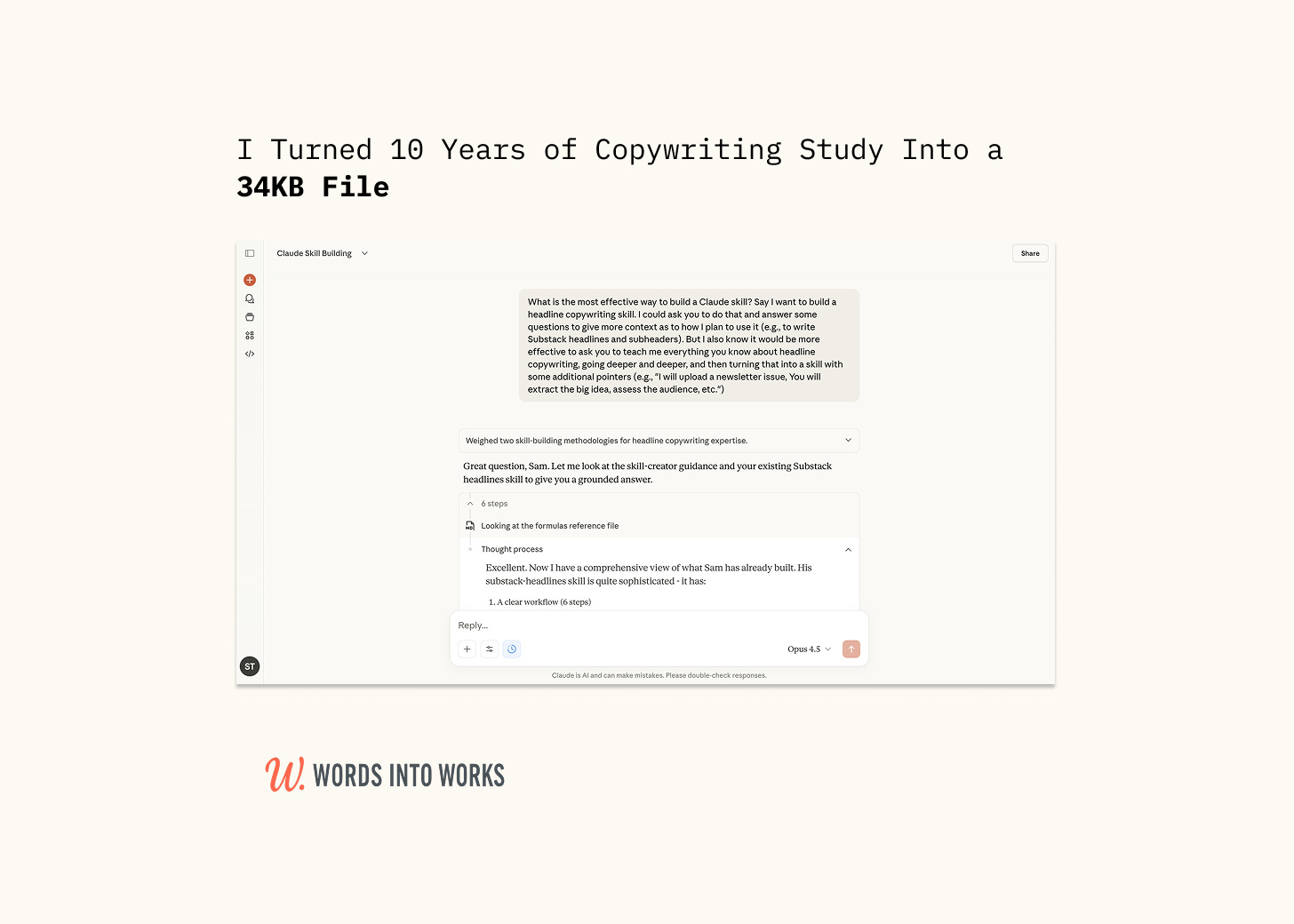
Before building my headline skill, I asked Claude directly: “What’s the most effective way to do this?”
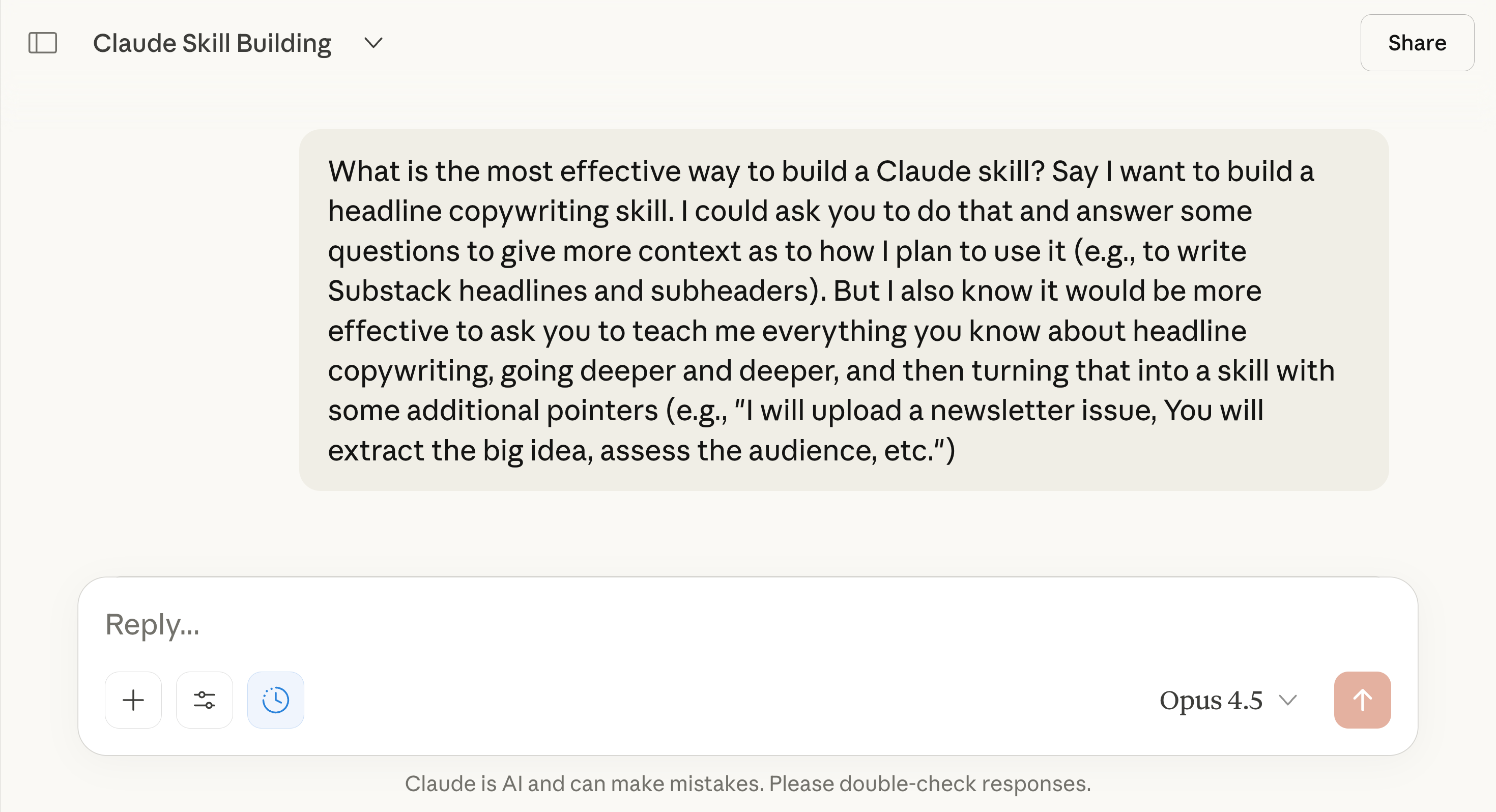
Its answer wasn’t what I expected.
