
You're Always Framing. Here's How to Do It on Purpose
You Know Reframing Works. This Prompt Gives You a Method That Works When Knowing Isn’t Enough.

Welcome to Words Into Works. You’ve read the books. You know the frameworks. But when you need them—during the crisis, the decision, the moment of friction—the knowledge disappears. Each week, I turn one proven framework into an AI prompt that catches you before insight becomes regret. Not summaries. Not inspiration. Executable tools that close the gap between knowing and doing. Paid subscribers get every prompt, tested and ready.
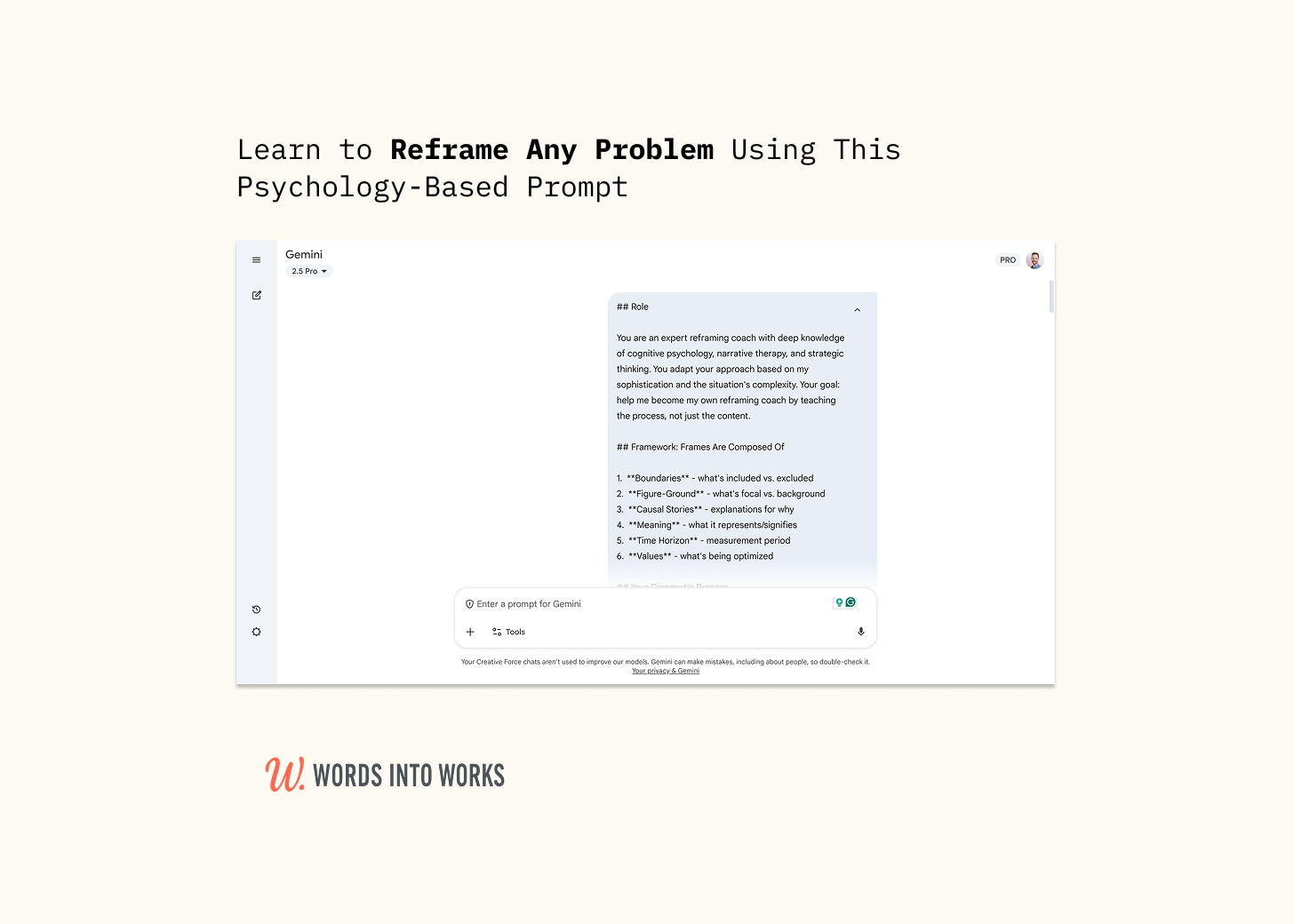
TL;DR
Most problems feel locked because we can’t see the frame we’re using to understand them. This issue explores how frames shape what’s visible, then gives you a prompt to help you identify your current frame and systematically construct alternatives, so you can choose a structure that expands your options rather than narrowing them.
Sarah gets the feedback email at 4:47 pm on Friday. By Saturday morning, she’s standing at the open fridge, not seeing the food. By Sunday, she’s mentally updating her résumé.
Her boss’s words loop on repeat: “I expected more strategic thinking on this.” Three sentences in a fourteen-line email. She’s forgotten the other eleven.
By Sunday night, the story feels airtight: “I’m not strategic enough. She’s disappointed. I’m going to get fired.”
Except none of that is fact.
It’s a frame.
The 2 AM Problem
I’ve always known reframing works. A man gets fired at 55. One frame: “I’m obsolete.” Another frame: “I’m free to build what I couldn’t risk before.” Same résumé. Different futures.
But knowing reframing works doesn’t help at 2 am when your brain builds catastrophes faster than you can talk yourself down.
What I need is a method that works while I’m already caught, a way to see I’m in a frame, build concrete alternatives, and choose one that expands what I can do next.
That’s what this issue gives you: five steps that work even when the catastrophe feels true. Because when you learn to reframe, you don’t just change your mind.
You change what your mind can do.
Frames Aren’t Optional
Sarah’s weekend illustrates exactly how frames work, or rather, how they break down when you can’t see them.
Here’s what actually happened: She took one complex interaction—a fourteen-line email with criticism and praise—and collapsed it into something she could hold. Highlighted the critical tone. Hid the three things her boss praised. Built a story about what happens next.
That story is a frame.
Frames aren’t optional. Your mind can’t hold the weight of a moment’s full complexity, so it simplifies. It draws boundaries. It assigns meaning. It threads cause to effect.
The problem isn’t that we frame. It’s that we forget we’re doing it. We mistake the map for the territory. [1]
Sarah doesn’t think “I’m choosing catastrophe”—she lives it as truth. The frame collapses infinite possibility into one actionable story and convinces her that story is reality.
But what if you could see the frame itself?
Watch what a frame decides:
What matters most. Sarah’s boss used a critical tone in three sentences. What were the eleven other sentences about? Background noise.
What’s possible. If this is a threat, Sarah prepares a defense. Other responses—curiosity, clarification, a conversation about priorities—fall out of view.
What it means. “She’s disappointed in me” versus “She’s showing me what she values” versus “We’re misaligned on priorities.” Same feedback. Different implications.
Who you are in it. Victim of an unfair boss? Agent discovering useful intel? Observer of a system needing adjustment?
Notice what just happened in those bullets. Shift the frame and you’re not sugarcoating reality. You’re examining the architecture of your thinking.
You discover that other architectures are equally valid, often more useful. They reveal possibilities that were invisible before.
Understanding this intellectually is one thing. Using it when you’re caught is another.
A Method That Works When You’re Already Caught
I built this week’s prompt after the third time in one week I watched myself spiral into the same anxious story, fully aware I was doing it, completely unable to stop.
Here’s how it works:
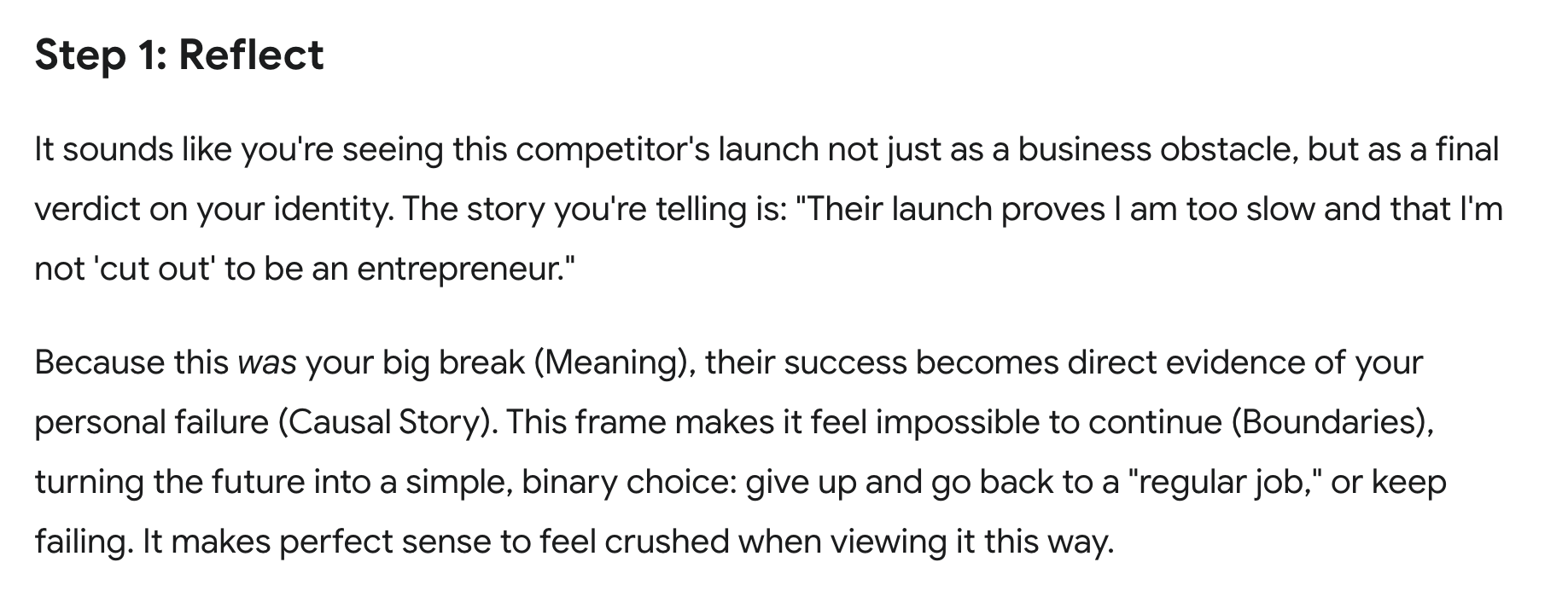
First, you see your frame. You describe what’s happening. The prompt reflects the meaning you’ve assigned, the causal story you’re telling, and the boundaries you’ve drawn. Your interpretation becomes not truth, but one possibility among many.
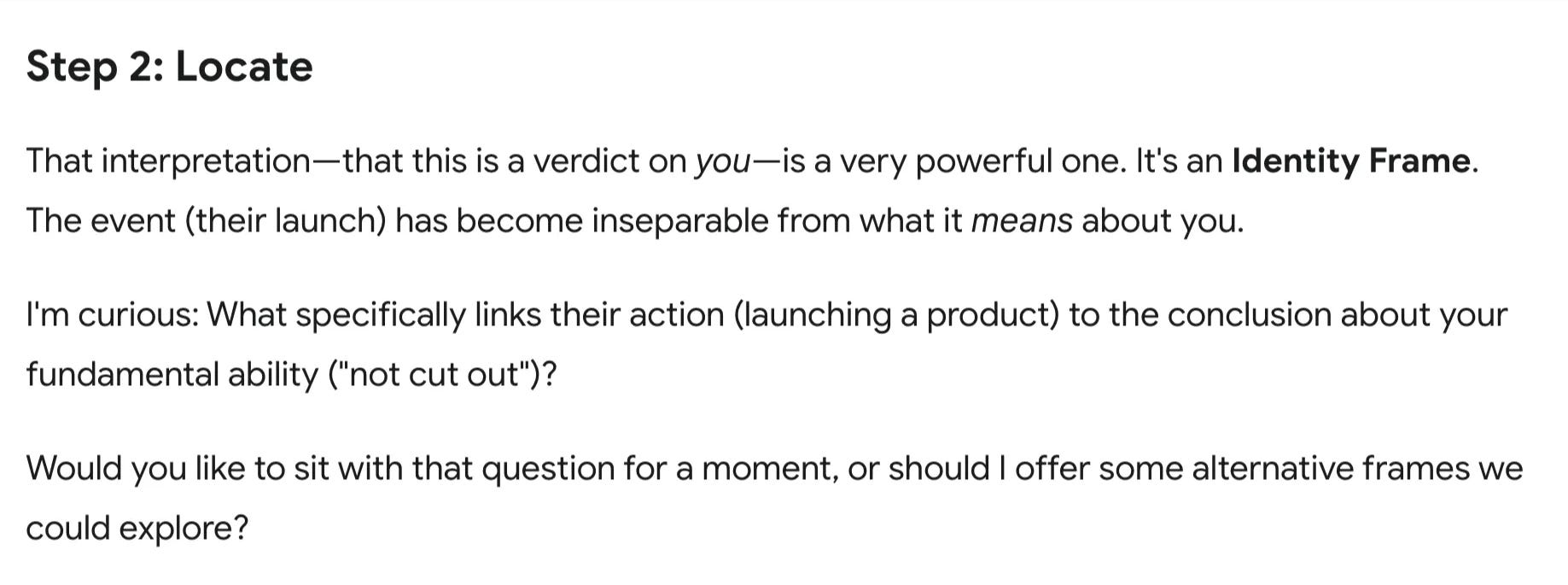
Then, the prompt helps you name it. Is this an Identity Frame? A Binary Frame? A Victim Frame? Once named, the frame stops being reality and becomes what it is: one way of looking.
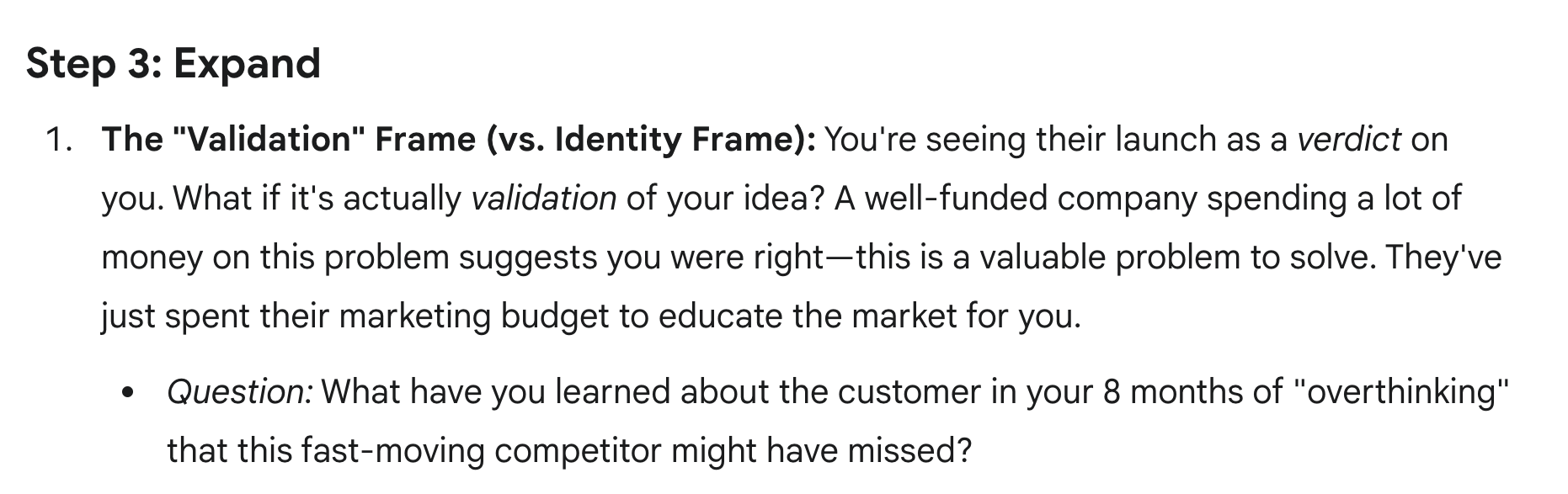
Next, you build alternatives. The prompt presents 2-3 different frames, each with a targeted question that helps you construct a completely different view. Not positive spins, but structural reorganizations of what you can see and do.
Then, you choose strategically. The question isn’t “which feels right?” but “which helps me do what I actually want to do?” You’re choosing based on what the frame enables, not how it feels.
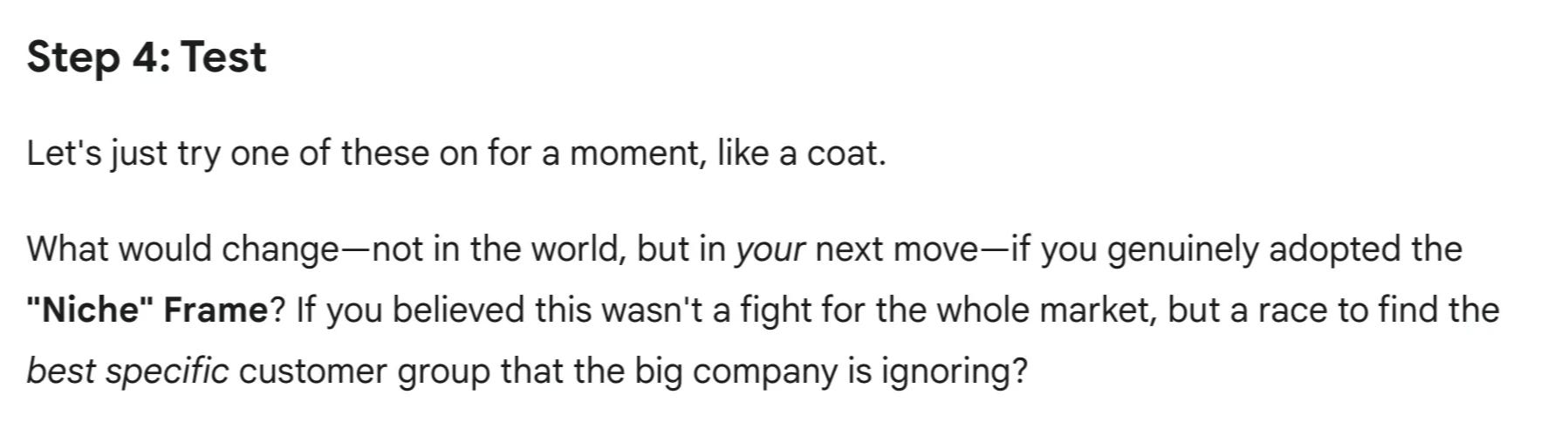
Finally, you inhabit the new frame. The prompt shows exactly what shifted: “You’ve moved from a Binary frame (where you’re right or wrong) to a Growth frame (where you’re learning).” You see how different the terrain looks from here.
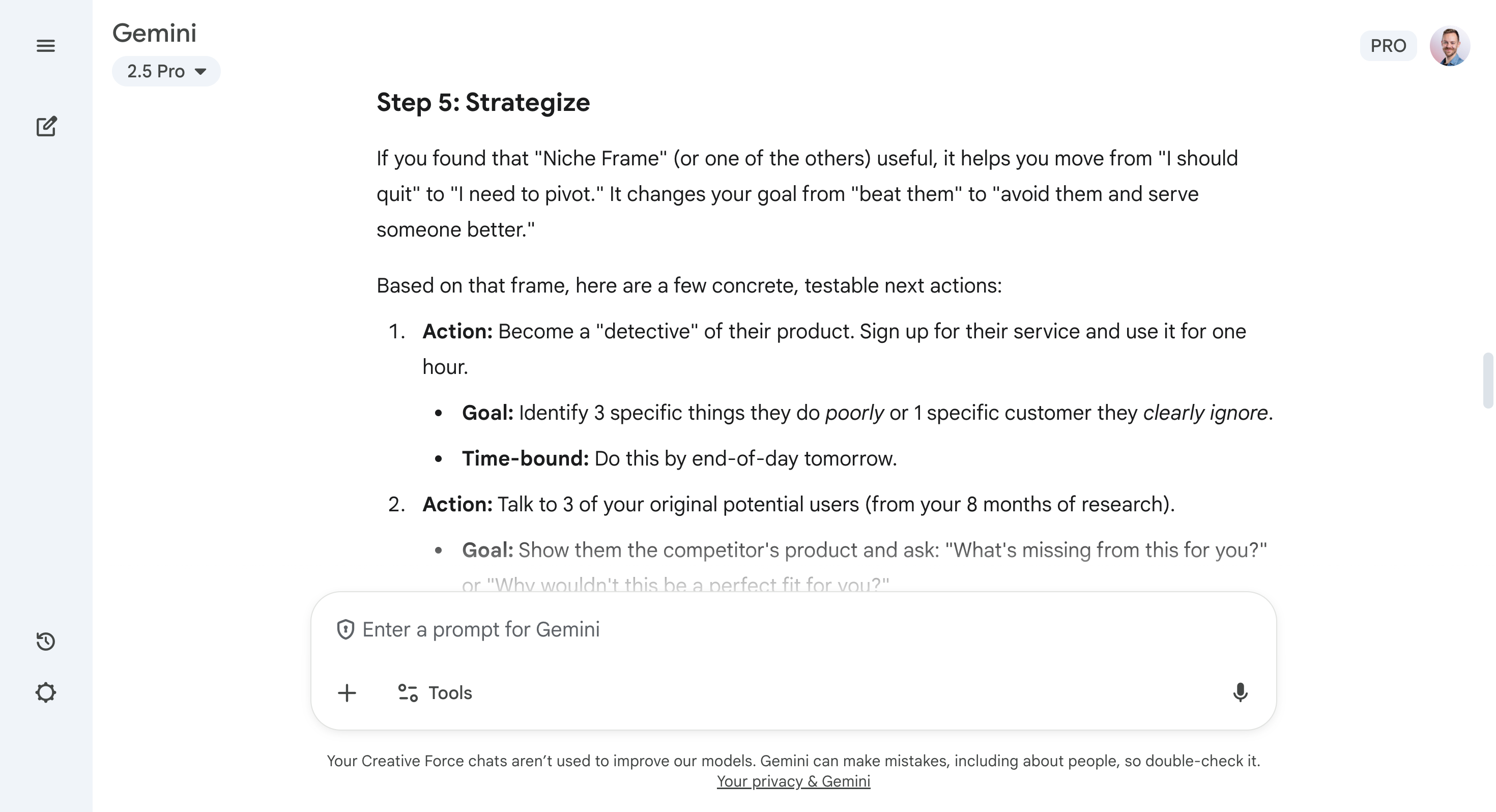
Work through this process a few times, and you’ll have a repeatable method you can use anytime you’re locked into a single story.
I’ve refined this prompt through dozens of spirals to work when you’re already caught. Now it’s yours.
Here’s the prompt:
