
Your Books Can Upgrade the Claude Skills You've Already Built.
Point AI at a Whole Book, Aim It at a Skill You Run, and Get Back a List of Exactly What to Fix.

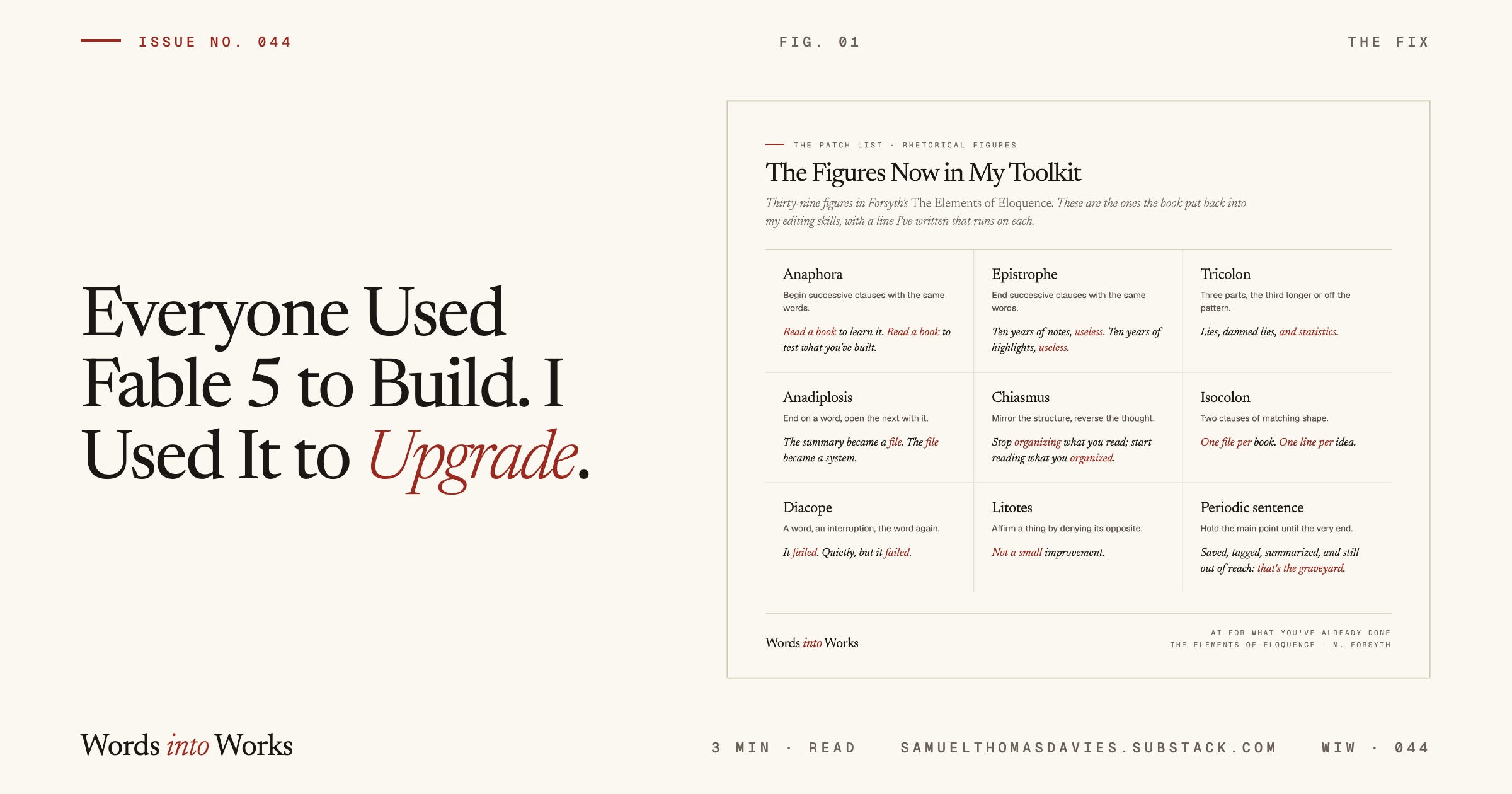
Last week I was editing an issue of Words Into Works when Claude, running as line editor, stopped on a paragraph and told me I'd written an anaphora (three sentences, each opening on the same two words).
The truth is I didn't know the word until the editor I'd built named it back to me. And if I'd used one such move without knowing its name, I'd surely used others. That's what nagged at me all week, until I did something about it: I went and found the book that names every last one of them.
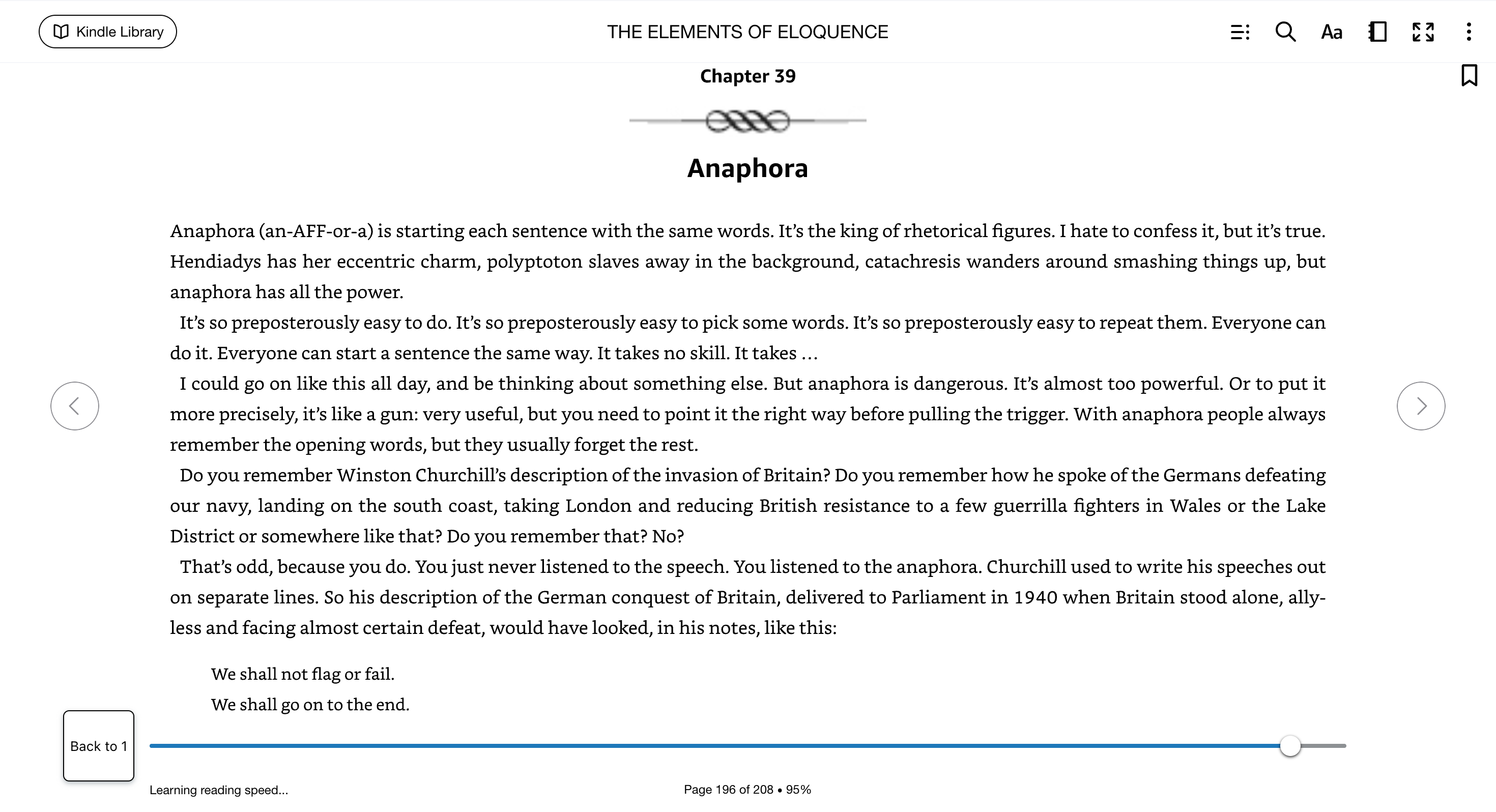
The book was Mark Forsyth's The Elements of Eloquence, and its whole argument is that the lines you can't forget are rarely found by feel. Instead, they're built. Thirty-nine figures of rhetoric, each with a name and a repeatable shape, and one of them was mine by accident.
A technique I couldn't name was a technique I couldn't repeat on purpose.
Everyone Used the Window to Build
For a few weeks this summer, Anthropic released a new model called Fable 5, one that could hold an entire book in context at once, then shut the window on July 19 and put it behind pricing most people won't pay.

Everyone I knew spent that window building something new. I spent mine on the opposite move. Rather than point Fable 5 at Forsyth's book to learn from it, I pointed it at a skill I'd already built and asked the book to make the skill better.
Mine happened to be one of my editing skills, but nothing about the move depends on that. Hand a book to a skill you run and it stops teaching you and starts auditing the tool: which techniques it already uses without naming, which it's missing, where each belongs.
Here that meant handing Fable all thirty-nine of Forsyth's figures and the skill that line-edits every issue, then asking for the patch list. That's the move almost everyone skipped. Read a book for its own sake and you come away with a vague sense of better.
Point it at a skill you've already built, by contrast, and you come away with a list of exactly what to fix.
The Fix I Didn't Know I Needed
The anaphora was the least of what the audit found. The sharpest catch was a mistake I'd coded into the skill months ago.
The last pass I run on any draft is a voice check (one of the three passes I edit with instead of generating from scratch): it reads for the spots where the writing stops sounding like me and starts sounding like nobody. It had been marking every rule of three as one of those spots.
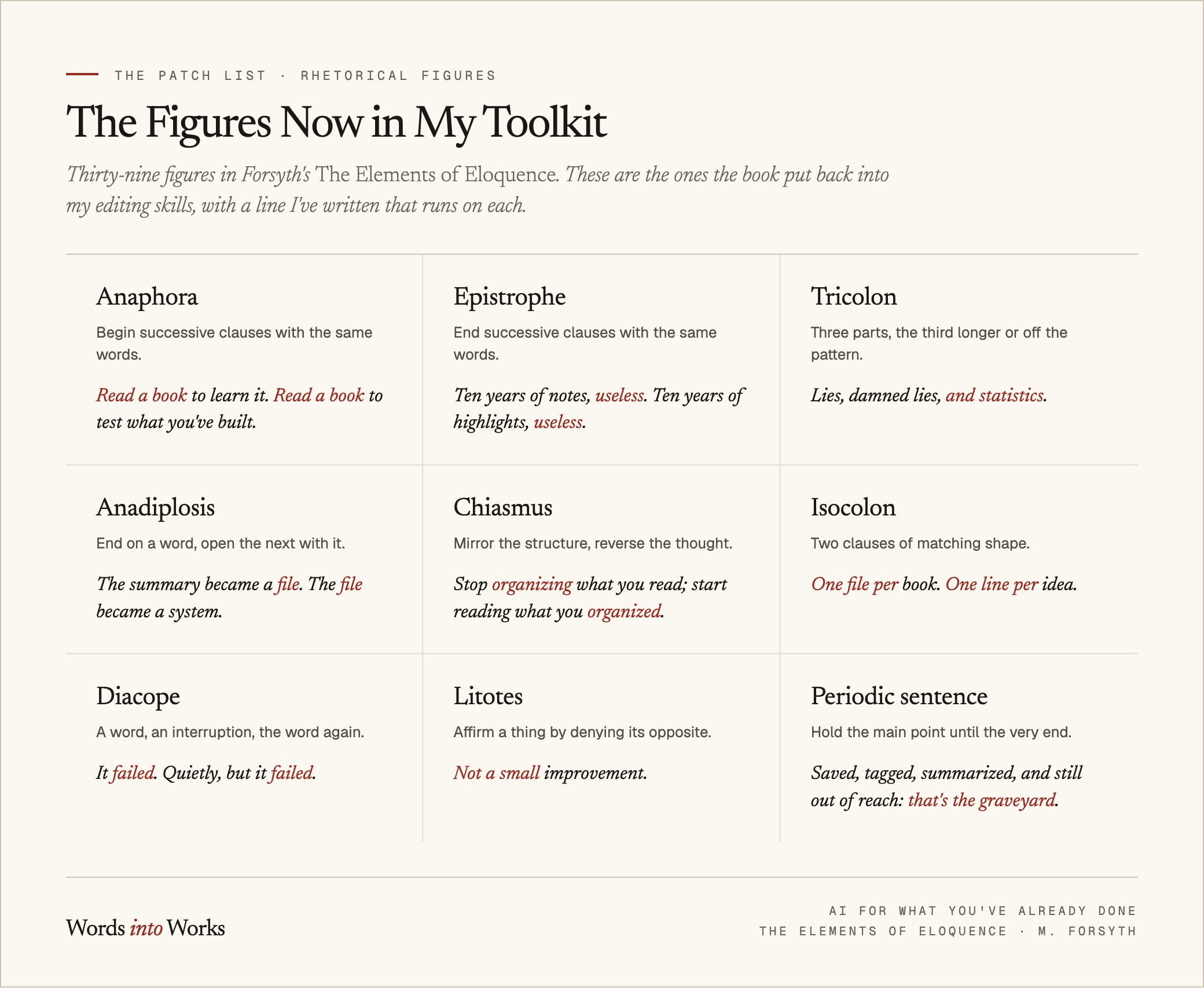
Forsyth's chapter on the tricolon says it was too blunt. The problem was never three. It was the balanced three, the kind whose items you could reorder without losing anything. A real tricolon swerves on the last element: it runs longer, or it breaks the pattern the first two set. "Lies, damned lies, and statistics." The third item is where the line earns its keep.
So I amended the skill to keep flagging the flat, shuffleable triad, and stop flagging the weighted one. (It wasn't the only patch; epistrophe was already in my copy editor as "echo." But the tricolon was the one that had been quietly wrong.)
A book can tell you what's missing, but it can't tell you which of the missing figures belong in your voice and which would only be ornament.
That call stays yours.
You Don't Need Fable 5 to Do This
By the time you read this, the window is shut. What it sharpened runs on every issue from here, on whatever cheaper model I point it at. Build a skill, prune the ones that drift, edit with the ones that work, and now, enrich them from the books you've already read.
My skill happens to edit sentences. Yours might do something else entirely. The move doesn't care what the skill does; it needs a skill you run often enough to want it sharper, and a book good enough to sharpen it.
The move never needed thirty-nine figures, either. Take a skill you already run and a book you own, and ask Claude to read the book against the skill and tell you what it's missing. The book becomes a patch list, and what you keep is the upgraded skill.
Forward this issue to whoever you know with a shelf of good books and a stack of good tools who's never introduced the two.