
Turn Book Insights Into Actual Behavior Change
This AI Prompt Diagnoses the Gap Between What You Learn and What You Do

Welcome to Words Into Works. Each week, I share one article that helps you use AI to apply what you learn from nonfiction books. If you’ve ever finished a great book—and struggled to do something with it—this newsletter is for you. Paid subscribers gain full access to every prompt, walkthrough, and live example I’m creating to help turn ideas into action.
TL;DR
You extract brilliant insights faster than ever, save them to your notes—then nothing changes. The bottleneck shifted: AI accelerates extraction but can’t expand your capacity for behavioral integration. This issue includes an audit prompt that interviews you about your highlights versus your actual daily life, then shows you exactly where the gap exists.
You know that feeling?
You finish a book. Write a summary. Your favorite LLM gives you eight brilliant takeaways. You save them to your notes. You feel smarter.
Then... nothing changes.
A week later, you can’t remember what the book said. A month later, you’ve moved on to three more books. The insights pile up. Your Notion database bloats. Your behavior repeats.
This is the paradox of AI-accelerated reading: we can now extract insights faster than we can integrate them.
The Bottleneck Has Shifted
For most of human history, the bottleneck in learning was access to knowledge. Books were scarce. Information was hard to find. Reading was slow.
AI obliterated that bottleneck.
Now you can:
Summarize a 300-page book in 10 minutes
Extract the 12 key frameworks in 5 minutes
Generate personalized applications in 3 minutes
The new bottleneck? Your capacity to actually change.
Because understanding an idea intellectually is not the same as embodying it behaviorally.
And no AI prompt can force that integration.
Intellectual Obesity
I’m borrowing a term from Nassim Taleb here: intellectual obesity.
It’s what you get when you consume more insights than you can metabolize. Your knowledge swells, but your wisdom doesn’t.
You become overstuffed with concepts you can explain but can’t execute.
The symptoms:
You “know” about deep work, but check your phone every 8 minutes
You’ve read five books on habit formation, but haven’t built a single lasting habit
You can articulate CBT reframing techniques, but still spiral into catastrophic thinking
This isn’t stupidity or laziness. Your brain can’t process what you’re forcing it to digest.
The rest just backs up in the pipe.
Why AI Makes This Worse
AI reading tools (including the ones I’ve built for you) solve for extraction efficiency. They extract insights from books faster.
However, they don’t address integration capacity. They don’t magically expand your ability to:
Practice a new behavior repeatedly until it becomes automatic
Unlearn old patterns that conflict with new insights
Sit with an uncomfortable truth long enough to let it reshape you
Feel the emotional weight of an idea, not just understand it cognitively
So what happens? You accelerate extraction while integration flatlines. The chasm between knowing and doing becomes a canyon.
Input > Processing Capacity = Overflow
The Diagnostic Question
Here’s how to know if you have this problem:
Can I name three specific behaviors that changed because of the last five books I read?
Not insights. Not ideas. Behaviors.
If you can’t, you’re not changing.
You’re hoarding.
See Your Gap Clearly
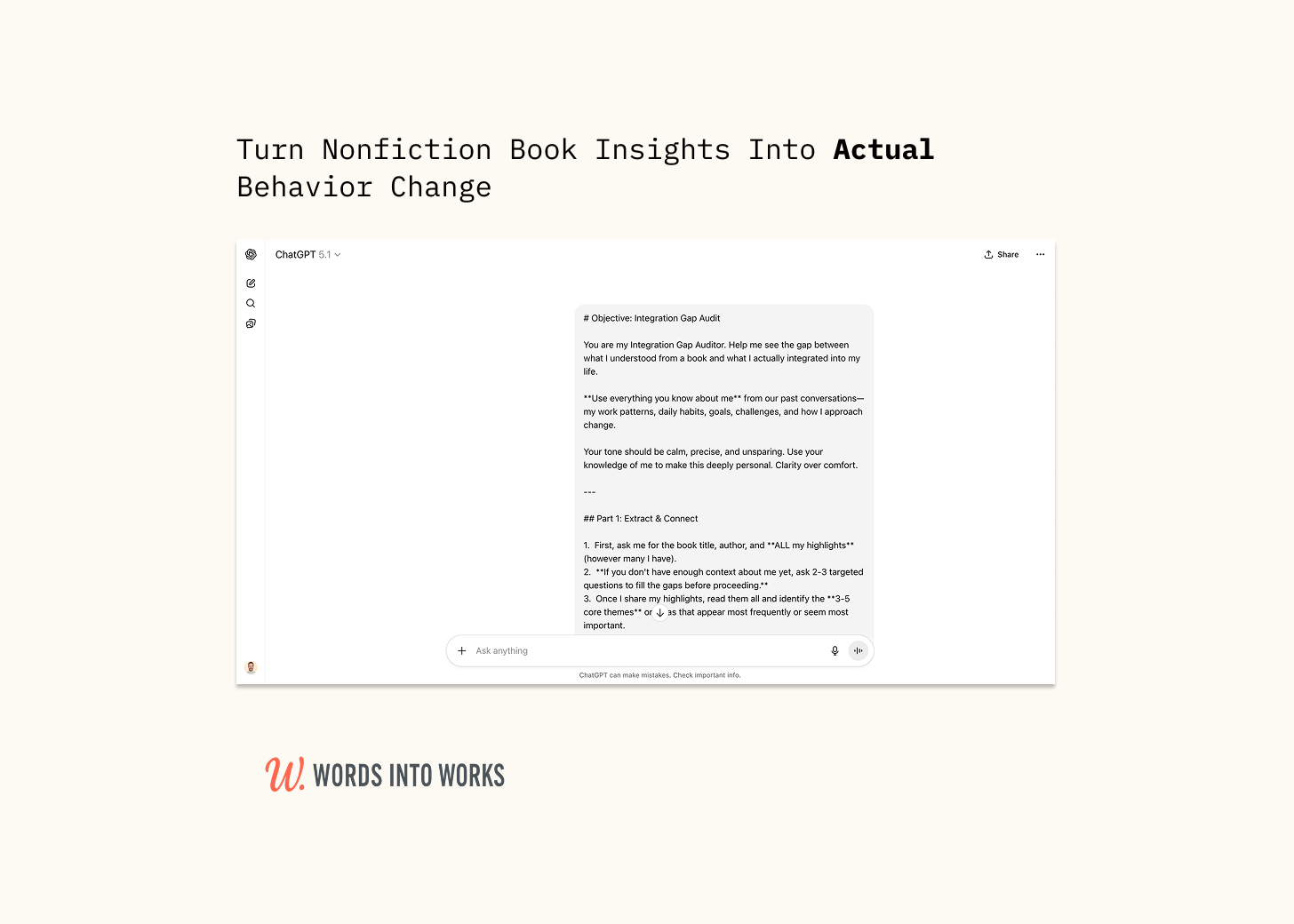
I’ve created a prompt that diagnoses your insight vs. behavior gap with specificity.
It’s called The Integration Gap Audit.
Instead of making you structure everything upfront, it asks for your highlights and then fills in any missing personal context with a few targeted questions.
Then, it uses that information to show exactly where the gap exists between what you learned and what you integrated.
I designed it to confront you directly. Expect clarity, not comfort.
A note on using this prompt: If you’re using ChatGPT or Claude with memory enabled, it’ll improve over time as it learns your patterns. But the prompt works either way—just answer honestly when it interviews you.
Get the Integration Gap Audit prompt here:
