
I Wrote Forty Issues. They Were All Secretly the Same Five Ideas.
A Year of Words Into Works, Distilled Into One Operating System.

Last year, this newsletter nearly ended.
It was a normal Thursday. I was eating breakfast before work, half-reading my inbox, when an email stopped me: serious, precise, clearly not spam or a phishing attempt. A law firm, on behalf of the publisher, had a problem with how I'd been using books in my writing.
Scary is the honest word for it.
The short version is I'd spent almost a decade turning nonfiction books into summaries (and for a few months, prompts for LLMs), and that email made it clear I couldn't keep building on books the way I had been.
It was absolutely gutting. Books had been the raw material here since 2015, and for a few weeks, I thought I'd lost my foundation. But then I realized I'd misread what the foundation was.
It was never the books themselves.
It was the ideas behind them, the systems for putting those ideas to work. Take the books away and I still had the part that actually mattered: everything I'd already accumulated (notes, ideas, decisions, transcripts, summaries), and a way to make AI reach it.
That reframe became Words Into Works 3.0.
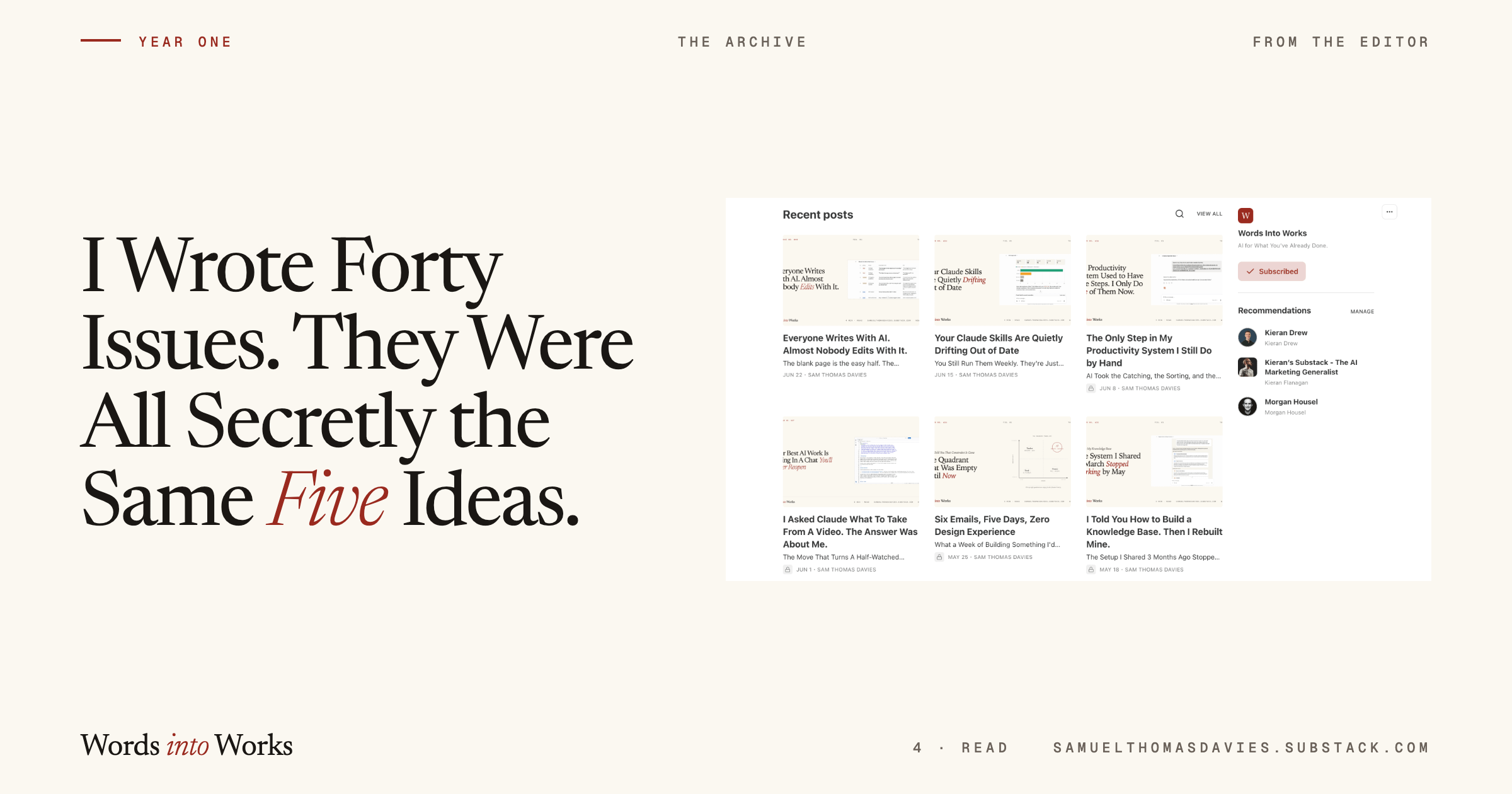
I've written more than forty issues since. And after reading some of them back this week, I saw something I couldn't see one Monday at a time: they keep circling the same five convictions. That's the operating system.
Here's the whole thing, and the issues that built each piece of it.
1. Your Past Work Is the Raw Material, if You Can Reach It
Start with the conviction everything else sits on: the knowledge you need already exists, and you've simply lost access to it.
I kept finding the same gap in different disguises. Meeting transcripts pile up and rot while you rebuild context from memory, the second brain you're proud of sits untouched for months (mine held 149 rated book summaries I almost never opened), full of notes Claude has never once seen, and your reading history stays an archive you browse instead of ammunition you load. Even your own chat history is a more honest record of your year than your journal, though you'd never think to open it.
These look like different problems, but they're actually the same one, and it isn't storage. It's retrieval. The material is already there; what's missing is the trigger to reach it the moment it matters.
That's the Accessibility Gap, and closing it is the whole job. Every system I've shared since the pivot is a bridge across it, a way to make AI load what you've already built before you ask, instead of leaving it where it's been sitting, unused.
2. The Blank Page Is the Smallest Thing AI Does
Most people meet AI at the blank page and stop there. Generate a draft, a first pass, something from nothing. That's the party trick, and it's the least valuable thing the tool does.
The leverage is on the work that already exists. Show it your worst draft (I once handed it forty half-finished slides at 11 p.m., three days before a webinar) and it turns into an art director, an editor, and a coach, depending on where you are in the project. Edit with it instead of just generating with it and you close the gap almost everyone leaves wide open, because everyone writes with AI now and almost nobody edits with it. When the output is technically correct but you're still staring at it, redesign what the output hands you next instead of rewriting the prompt. And when you can't afford the expert whose judgment you need, you can build the stand-in and get the feedback anyway.
None of it starts from zero. Every move takes something that already exists (a draft, an output, a decision you've already made) and puts AI to work improving it, pressure-testing it, or reacting to it.
The blank page is where AI is weakest, because it's the one place you've handed it nothing of yours to work with.
3. Taste Is the Last Bottleneck
Hand AI everything you've got, and one thing still stays yours. Once it clears the brief, something uncomfortable shows up: the output is competent and still not good, not wrong so much as generic. What separates "fine" from "yours" is taste, and that's the part you can't hand off.
But you can encode it.
Your taste is the last bottleneck, and the move is to reverse-engineer your own standard from the work you've already judged, then wire it in as a scorecard (mine runs ten criteria) the AI has to clear before a draft ever reaches you. The standard was always in your head, but now it runs on every output automatically.
And if that sounds like it takes more expertise than you've got, you're better at this than you feel. Competence with these tools compounds through reps inside them, not through the content in your feed, so the distance between how good you actually are and how good you think you are is usually wider than you'd guess.
4. Systems Beat Hacks, But Systems Rot
Encoding your taste that way is building a system, and systems are what I reach for first. A hack gives you a win once; a system gives it to you every time, which is why almost everything I build ends up reusable rather than a clever one-off. I compressed ten years of copywriting study into a single 34KB skill. I turned the best work buried in an old chat into a skill that keeps producing. I watched a five-step productivity system collapse into one step once I encoded the method and let AI run the rest.
But every system has the same flaw: it rots.
Every correction you save becomes a permanent rule, and enough of them quietly strangle the output until everything sounds like a committee wrote it (I've shipped that draft more than once). Skills you built months ago keep running against a world that moved on, drifting out of date while still shaping every decision the model makes for you. Building the system is the easy half. But maintaining it, pruning it, and knowing when to delete instead of add? That's the rare discipline.
5. The Real Game Is Loop Speed
Retrieval, editing, taste, systems: none of it pays off unless the loop underneath runs fast. Everyone obsesses over inputs: more tools, more prompts, more tips saved for a someday that never comes. But the thing that actually compounds isn't how much you take in. It's how fast you close the loop between trying something and learning whether it worked.
That's what AI upended. Feedback that used to be slow and generic is now instant and specific to your exact attempt, which bends the whole improvement curve: one percent better every day compounds to 37.78x over a year, one percent worse collapses to 0.03. The old trade-off (fast feedback or useful feedback, pick one) is gone.
So the leverage sits on the far side of the input, in what you do the moment after. The gap that stops books from changing you is the same gap that stops most AI content from changing you: you collect the insight and never run it. And the tips you keep saving don't close any loop until you grade them against the setup you've already built and change something.
Speed of the loop, not size of the input. That's the game.
A year ago, over breakfast, I was sure that email was the end of this newsletter. It turned out to be the start of the version you're reading now.
Losing the books forced me to find what was underneath them, and a year of Mondays turned that into five convictions and one idea holding them together:
AI is for what you've already done.
The raw material changed. The job didn't. That's year two.
If you're enjoying Words Into Works, send it to someone who still opens AI to a blank page.